A customer reports a problem with a consignment, a residue analysis comes back above the limit, or a supplier announces a fault in a packaging material. From that moment, what separates a recall of a few pallets from a recall of the whole week is traceability: knowing within minutes where that fruit came from and where it went. This article explains what the regulations require and how to act step by step.
What the regulations require
The foundation is Regulation (EC) 178/2002 (the EU general food law), which sets out the general principles of food legislation:
- Article 18, traceability: traceability must be ensured at all stages of production, processing and distribution. Every operator must be able to identify who supplied them with a food and which businesses they have supplied it to. This is known as "one step back, one step forward".
- Article 19, recall: if an operator considers, or has reason to believe, that a food it has imported, produced, processed or distributed does not meet food safety requirements, it must immediately start withdrawing it and inform the competent authorities. If the product may have reached the consumer, the operator must inform them effectively and, if necessary, recall what has been supplied.
In Spain, Ley 17/2011, de seguridad alimentaria y nutrición (Spain's Food Safety and Nutrition Act), refers back to these obligations. The AESAN (Spanish Food Safety and Nutrition Agency) traceability guide points out that the rules require a traceability system to be in place, but do not impose a specific method: each business decides how to organise it, as long as it works.
The first steps when the alert goes off
- Identify the exact batch. Using the pallet or box label, find the dispatch, the date, the packing and the batch or traceability code.
- Block whatever is left in the warehouse. All stock of that batch, and of any batches that share the same origin, is set aside and marked as not to be dispatched until things are clarified.
- Trace backwards. Which incoming delivery notes does it come from? Which growers, plots and dates? Which materials in contact with the fruit were used: packaging, punnets, film?
- Trace forwards. Which other dispatches carried fruit from those same intakes? To which customers and distribution centres, on what date and with how many packages?
- Define the scope. With the two lists you decide the extent: just that batch, all batches from a specific intake, or all those from one grower on certain dates.
- Notify. Inform the affected customers, with the details of each consignment, and the competent health authority.
- Document everything. What was detected, when, what decisions were taken, what has been recovered and what happened to it.
Why some recalls are small and others huge
The difference is almost never down to how serious the problem is, but to how precise the records are. Compare two situations, as an example:
| Situation | What you can prove | Scope of the recall |
|---|---|---|
| Every pallet carries a code linked to its source intakes | Which growers and plots are behind that pallet | The pallets that share that origin |
| Only the day it was packed is known | That it left the line that day | All production from that day, perhaps from several days |
| The batch of packaging used is not recorded | Nothing about the material | Everything packed while stock from that supplier lasted |
A traceability system does not prevent the problem, but it greatly reduces what has to be recalled, what you have to pay and the time your customer spends waiting for an answer.
Common weak points in a fruit warehouse
- Batches that are too large: when handling mixes fruit from many intakes on the same line without recording it, any incident drags everything down with it.
- Intakes without a plot: if the delivery note only names the grower, you will not be able to narrow things down to a specific plot.
- Materials with no trail: punnets, film or boxes for which you do not know which of the supplier's consignments was used.
- Labels that cannot be searched: a printed code that is not recorded anywhere is no use for following the thread.
- Data on paper or in several spreadsheets: reconstructing a consignment from folders takes hours that you do not have during an alert.
Run a drill before you need it
The simplest way to know whether your traceability works is to test it. Pick a pallet dispatched a few weeks ago and time how long it takes you to answer these questions:
- Which intakes, growers and plots does it come from?
- Which packaging and materials were used?
- Which other dispatches carry fruit from those same intakes, and to which customers?
- How much stock from those intakes is left in the warehouse?
If any answer requires phoning several people or going through paperwork, you know where to improve. Repeat the exercise at different times of the season, including the busiest ones.
What information to send to your customers
When you notify a customer of a recall, they also have to locate the product in their warehouses and, if they have already sold it, in their shops. The more specific your communication, the sooner they will find it. Include at least:
- Product, variety and pack type, with the brand shown on the label.
- Batch or traceability code exactly as printed on boxes and pallets.
- Number and date of each affected dispatch, with the delivery centre.
- Number of pallets and packages in each dispatch.
- Reason for the recall, in clear terms.
- What they must do with the goods: hold them, return them or destroy them, and how this is documented.
Keep a copy of every communication and of the customer's reply. That documentation is what later proves that you acted with due diligence.
How Agrocom solves it
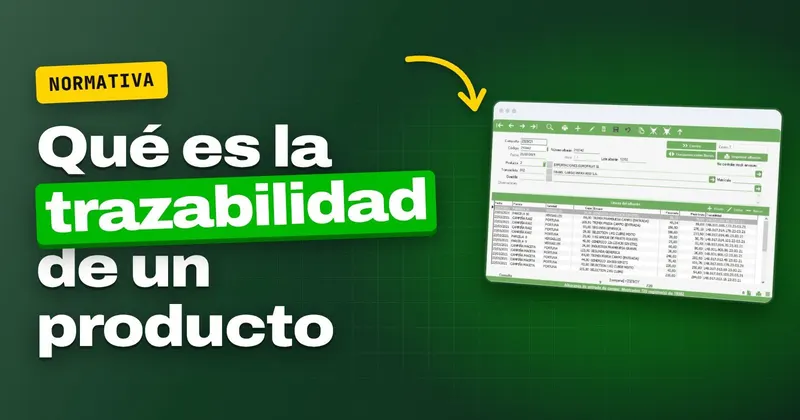
Agrocom keeps full traceability of the fruit and of the materials in contact with it, from the incoming delivery note, with its grower, plot, variety, boxes, packaging and weights, through to the dispatch to the customer. If there is any incident with a consignment, you get its traceability immediately.
The inbound and outbound control panel shows the stock of fruit still to be dispatched, and the label editor carries the traceability data onto the label of each pallet or punnet. More detail in traceability and labels.