A customer calls because a batch has arrived with a problem and asks which farm it came from. Being able to answer with the delivery note in front of you is product traceability: following each batch back to the grower and forward to the customer. Below you will find what the European rule that requires it says, who it applies to in the fruit chain, what data you need to link in the warehouse and what to check before the first deliveries of the season.
What is product traceability?
Traceability is being able to reconstruct the path of a food: where it came from, where it went through and where it went next. In a fruit warehouse it boils down to one concrete question: given a box that is in a customer's warehouse, which goods-in delivery note does it come from, which grower and which plot?
It is summed up as “one step back, one step forward”. Backwards, you know who delivered the fruit to you: the farmer or the member. Forwards, you know who you delivered it to: the retailer, the wholesaler or the importer. What happens in between, at reception, on the handling line and at the loading dock, decides whether the answer arrives in a few minutes or in two days.
What Regulation (EC) 178/2002 requires since 01/01/2005
The obligation is set out in Article 18 of Regulation (EC) 178/2002, the European general food law. It has applied since 01/01/2005 and requires you to know who each product is received from and who it is delivered to.
Article 18 asks for both ends: the supplier and the customer of each product. How you link one with the other inside the warehouse is up to you, and that decision determines whether a complaint affects a single batch or everything shipped in a week.
The guide to Regulation 178/2002 explains this in more detail. In this post we focus on what you need to do in the warehouse.
Who is affected in the fruit chain
You are covered as soon as your warehouse receives fruit from growers and delivers it to customers. It makes no difference whether you are a marketing company, a cooperative or a warehouse working for third parties: at each of these points you must be able to say what came in and what went out.
- Reception of fruit from growers and members.
- Handling and packing, where several deliveries end up in the same batch.
- Dispatch to customers, both in Spain and in other countries.
The rule does not tell you which tool to use. The foreman's notebook and a spreadsheet will do as long as someone can read them on the day of the complaint. The problem comes when that person is not there, or when boxes from three farmers were mixed on the line without being recorded.
What data links a batch in the warehouse
This table summarises what to record at each stage so that the chain is not broken:
| Stage | What to record | What it is for |
|---|---|---|
| Goods in from the field | Date, time, farmer, plot, variety, packaging and net weight | The step back: knowing who delivered the fruit to you |
| Handling | Which goods-in delivery notes make up each batch, packing format, grade and brand | Joining what came in with what goes out |
| Labelling | Traceability code on the box, the punnet and the pallet | So the product itself says where it comes from |
| Dispatch | Customer, delivery point, packing format, variety, packages and net weight | The step forward: knowing who you delivered to |
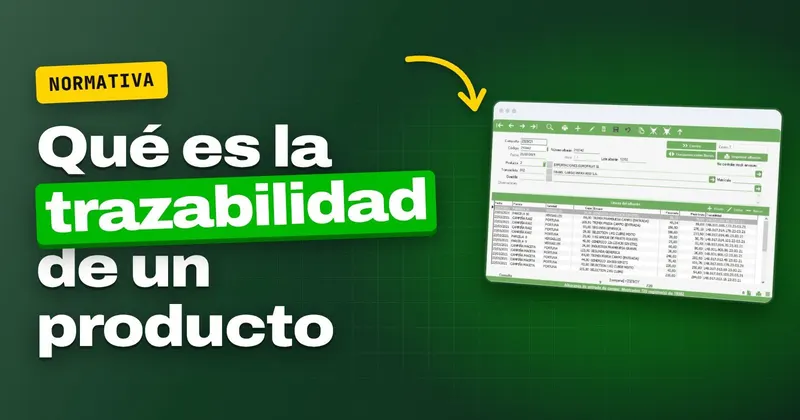
With the farmer waiting with the trailer, the delivery is logged in a hurry, and that is where the chain can break. In Agrocom, from Infonet Consultores, the goods-in delivery note records the date, time, farmer, plot and net weight, and the farmer signs it on the tablet before leaving. Each line carries its traceability code.
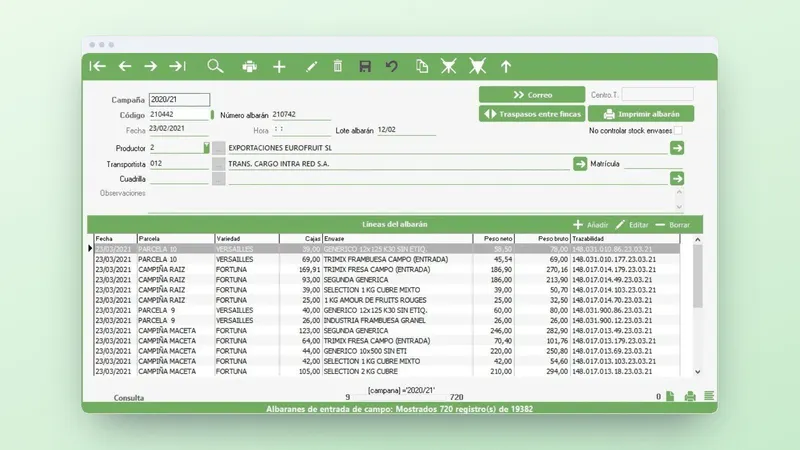
That code has to end up printed on what goes out. With the Agrocom label editor you design each customer's label with the batch and the traceability code from the delivery note, without any other program. What else the box must carry is covered in the post on labelling of fruit and vegetables.
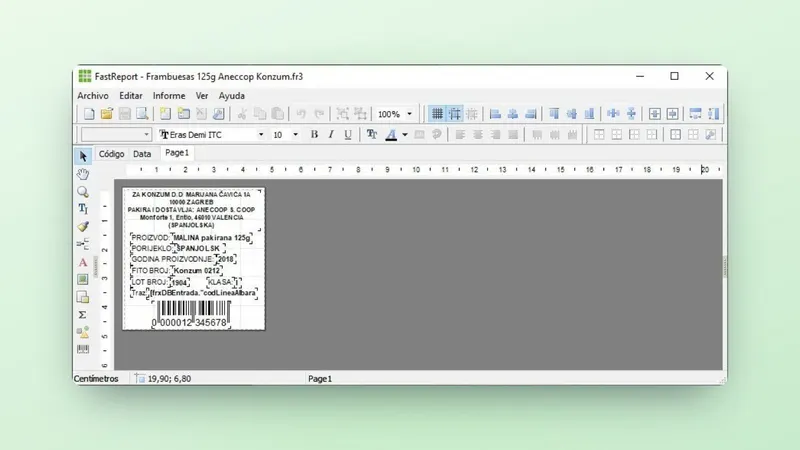
With a paper delivery note and the label code entered by hand, every step is a place where the link can be lost. In Agrocom the signed goods-in note, the batch and the dispatch are joined in the same traceability system: request a demo with your own warehouse data.
What happens when a batch fails and you cannot trace it
When the complaint arrives, the customer wants to know what else you have sent them from that source. If the link was broken on the handling line, you will have to treat all of that day's deliveries as suspect, and the recall grows. With everything properly linked, you point to one grower, one plot and the dispatches that carried their fruit.
Agrocom finds the traceability of a batch instantly: from the dispatch you reach the goods-in delivery notes and the related growers. How to organise the notification to customers and authorities is explained in the post on recalling a batch of fruit.
And the materials that touch the fruit
A complaint about a box may be down to the fruit or to the packaging. That is why Agrocom handles traceability of the fruit and also of the materials in contact with it: boxes, punnets and other packaging that go into each packing run. This works as long as the packaging stock is up to date; boxes you lend to farmers and nobody records throw the count off. You can see how to manage them in the post on control of field packaging and pallets.
What to do before the first deliveries of the season
- Review the goods-in delivery note: each line should carry farmer, plot, variety, packaging and net weight, and the farmer should sign it.
- Decide which traceability code goes on each customer's label and check that it comes from the delivery note, not typed in by hand.
- Run a drill: take a box that has already been dispatched and find its grower and its plot. Time how long it takes.
Did the drill take longer than a customer on the phone would put up with? Request information and we will show you the journey of a batch in Agrocom. You can also call +34 959 54 07 12 or message us on WhatsApp on +34 621 39 39 47.