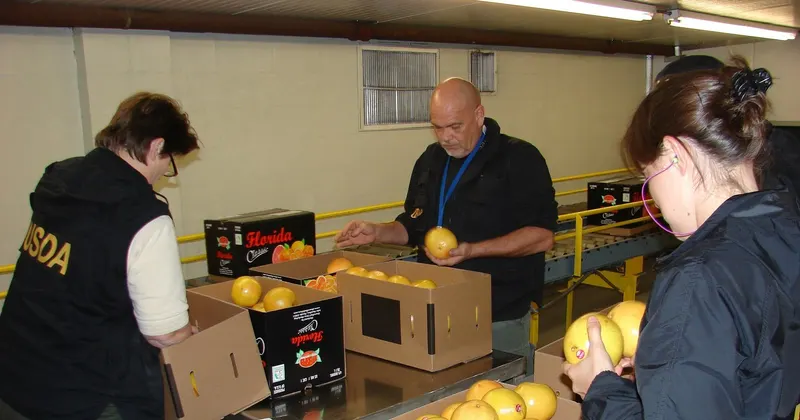
Everything a fresh fruit and vegetable marketer sells has to meet marketing standards that are common across the European Union: minimum quality requirements, classes, sizes, tolerances and marking details. Since 1 January 2025 those standards have been set out in a new regulation, and in September 2026 Spain updated the list of products it checks in foreign trade. This article summarises what you need to know to work with them.
Which regulations are in force
- Delegated Regulation (EU) 2023/2429: sets the general marketing standard, the specific standards and the marking rules. It repealed, among others, Implementing Regulation (EU) 543/2011, which was the sector's reference for years. It has applied since 1 January 2025 (Article 11).
- Implementing Regulation (EU) 2023/2430: governs the checks on compliance with those standards. It has also applied since 1 January 2025.
- In Spain, for foreign trade, Orden PRE/3026/2003 (the Spanish ministerial order on quality control of fruit and vegetables in foreign trade) and its annex, replaced by Orden ECM/1002/2026, in force since 27 September 2026.
General standard and specific standards
Each fresh product meets one of two standards:
| Specific standard | General standard | |
|---|---|---|
| Products | Apples, citrus fruit, kiwi fruit, lettuces and endives, peaches and nectarines, pears, strawberries, sweet peppers, table grapes, tomatoes and bananas | All other fresh fruit and vegetables covered by the regulation |
| Quality | Minimum requirements and classes Extra, I and II, each with its own tolerances | Minimum quality and maturity requirements |
| Size | Sizing rules specific to each product | No sizing rules in the general standard |
| Marking | Identification, nature of the produce, origin, commercial characteristics and optional official control mark | Identification of the packer or dispatcher and country of origin |
The general standard requires, among other things, that products are intact, sound and clean, with a degree of development and maturity that allows them to arrive at their destination in good condition. In each lot it allows a 10% tolerance, by number or weight, of produce that does not meet the minimum requirements, and within that no more than 2% affected by rot. A product subject to the general standard is also considered compliant if the holder shows that it meets an applicable UNECE standard.
The specific standards are far more detailed: they define the defects allowed per class, minimum sizes, uniformity of the package and presentation. If you work with any of these products, keep the text of the relevant standard to hand: the difference between Class I and Class II comes down to details.
Exemptions worth knowing about
Article 5 of Regulation 2023/2429 excludes from the standards, among other cases:
- Products clearly marked as "intended for processing" or for animal feed, among other direct non-food uses.
- Direct sales from the producer to the consumer for personal use, at local markets or by direct delivery.
- Products intended for donation, which carry that statement and must meet the general standard except as regards marking.
- Certain products, such as several nuts, non-cultivated mushrooms or saffron, which fall outside the standard but must indicate their origin.
There are also exemptions within a single production region, for example for fruit that goes from the producer to a conditioning centre (Article 5.2). This is what allows fruit to reach the warehouse from the field before it has been graded.
Origin, always in view
The country of origin is the statement that recurs most often in the regulation. It must appear on the package, on the pallet label, in consumer information in retail sales and in distance selling (Articles 6 and 7), and also on invoices and accompanying documents, except for consumer receipts (Article 6.4). For mixes in packages of up to 10 kg containing products from several countries, the origin can be expressed as "Originating in the EU", "Not originating in the EU" or "Originating and not originating in the EU" (Article 8).
Who checks and how
Regulation 2023/2430 requires each Member State to maintain a database of operators in the sector (Article 3) and to organise checks on the basis of risk analysis (Article 5): not everything is inspected, only what is most likely to be non-compliant, taking into account, among other factors, the results of previous checks and whether the operator has a self-checking system. The regulation also provides for the approval of operators (Article 4) and the certificate of conformity for export (Article 7 and Annex III).
In Spain, commercial quality control of products exported to or imported from third countries is carried out by the Soivre inspection service (Spain's official foreign trade inspection service), under Orden PRE/3026/2003. The new annex approved by Orden ECM/1002/2026 separates the products subject to full checks from those checked only for their country of origin. On the internal market, monitoring falls to the authorities designated by the competent administrations; find out which one applies to you.
What to do in the warehouse
- Draw up a table with each product you market and the standard that applies to it.
- For products with a specific standard, define the class and size for each pack type, and make sure operators can see them on the line.
- Check your box label and pallet label templates against the marking requirements of each standard.
- Record internal quality checks by batch: they are your best argument in an inspection and form part of the risk analysis.
- Keep the country of origin on your sales documents.
How Agrocom handles it
In Agrocom you have farm, plot, variety, pack type, size and brand data one click away, and you can create made-to-measure pack types with their costings. The built-in label editor lets you design pallet and punnet labels with barcodes and traceability data, and fruit traceability runs from goods in to dispatch. You can see it under traceability and labels.
If you export, Agrocom also prepares the Soivre and Intrastat reports: you will find them under invoicing, Intrastat and Soivre.