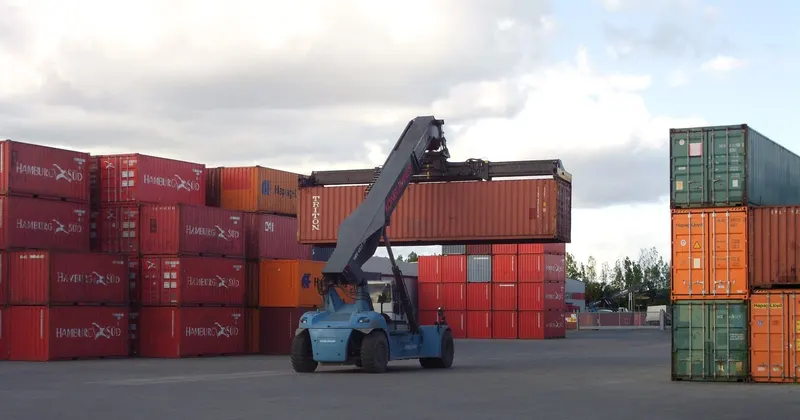
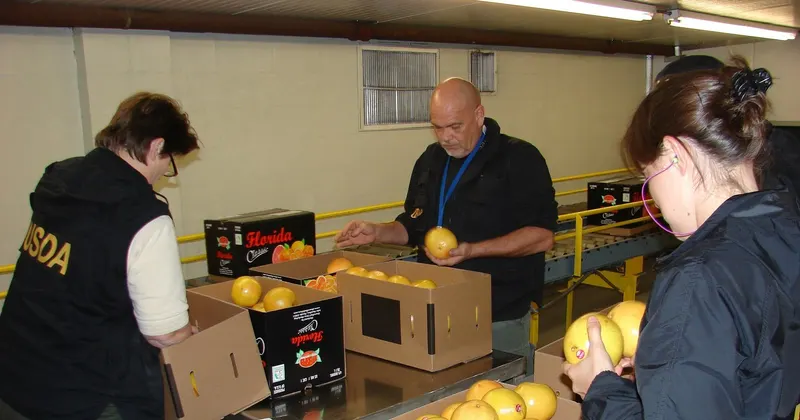
If you sell fruit or vegetables outside the European Union, the lorry or container needs to pass a commercial quality check before it leaves: confirming that the goods meet the marketing standards that apply to them. In Spain, this check is carried out by Soivre. This article explains what it is, when it affects you, how to request it and what to have ready so that the inspection does not delay your load.
What Soivre is
Soivre is the name by which the whole sector knows the inspection service of the Territorial and Provincial Trade Directorates (Direcciones Territoriales y Provinciales de Comercio), which come under the Ministry of Economy, Trade and Business (Ministerio de Economía, Comercio y Empresa). According to the ministry itself, it carries out the inspection and commercial quality control of the foreign-trade products set out in the regulations.
The Spanish reference rule is Orden PRE/3026/2003, of 30 October (the Spanish order laying down the inspection and control rules for these directorates). Article 1 makes its scope clear: it controls the commercial quality of the foreign-trade products included in its annex, and operations with other EU countries are inspected only where this is established under European rules. In other words, Soivre mainly affects you when you export to non-EU countries.
Which products go through the check
The annex to that order has just changed. Orden ECM/1002/2026, of 9 September, published in the BOE (Spain's Official State Gazette) on 26 September 2026 and in force from the following day, replaces the annex to bring it into line with the current European framework. The new annex has five parts:
- Part A: imported products subject to marketing standards control.
- Part B: exported products subject to that same control.
- Parts C and D: imported and exported products for which only the indication of the country of origin is checked (for example, certain nuts or dried fruit).
- Part E: minimally processed products, for which only the country of origin is verified.
Before closing a sale to a non-EU country, look up your product and its code in part B or part D. This determines whether the inspection is a full one or an origin-only check.
The standards checked are European: Delegated Regulation (EU) 2023/2429, with the general standard and the specific marketing standards, and Implementing Regulation (EU) 2023/2430, which governs conformity checks. Both have applied since 01/01/2025.
How to request the inspection
According to the ministry's information on commercial quality control:
- Prior registration. The company registers with the Soivre inspection service.
- Online request. The inspection request is submitted through the ESTACICE platform, with the consignment details.
- Inspection. It takes place at the points designated by the service or, with prior authorisation, at the customs premises themselves. The ministry also envisages authorising checks at the operator's warehouses designated as an authorised depot or location, although this does not guarantee that the check will always be carried out there.
- Result. If the goods conform, a conformity decision and the Soivre certificate are issued, and the certificate is declared in the customs document for clearance.
- Non-conformity. In some cases it is considered remediable: it is corrected on the premises, rechecked and the certificate is issued.
For its part, Regulation 2023/2430 requires Member States to maintain a database of operators in the sector (Article 3), checks to be carried out on the basis of risk analysis (Article 5), and customs to accept the export declaration when there is a certificate of conformity or the control body confirms it (Article 6). The certificate template is in its Annex III (Article 7). The regulation also provides for the authorised operator status (Article 4), with its own requirements. This article does not set specific request deadlines: check them with your inspection service.
What the inspector looks at
The check confirms that the consignment meets the standard that applies to it. In practice, the inspector looks at:
- Minimum requirements: whole, sound, clean produce, free from pests and damage, with sufficient ripeness.
- The declared class (Extra, I or II for products with a specific standard) and the tolerances for each.
- Size and uniformity within each package.
- Presentation: packaging that protects the produce and a visible part that is representative of the whole.
- Marking: identification of the packer or dispatcher, nature of the produce, country of origin and commercial characteristics, on each package and on the pallet label.
- Document match: that what is seen on the pallet matches what was declared in the request.
Mistakes that delay the load
- Declaring in the request a class or size different from the one on the label.
- Pallets with packages of several pack types mixed together without identification.
- Labels without a country of origin or with an incomplete packer code.
- Requesting the inspection when the lorry is already at the gate.
- Not knowing which incoming deliveries the fruit in a rejected consignment came from, which makes it impossible to rework it sensibly.
A good habit is to prepare a sheet for each consignment with the number of pallets, packages, pack type, variety, class, size and net kilos, and to check it against the labels before requesting the inspection.
How Agrocom solves it
Agrocom has Soivre reports ready to submit, alongside the Intrastat ones. The data comes from the shipment itself: customer, site, carrier and the consignments with pack type, variety, packages, weights and prices, and the CMR is generated automatically.
Its own label editor lets you design pallet and punnet labels, with barcodes and traceability data, and fruit traceability runs from the incoming delivery note through to dispatch. It is explained in traceability and labels and in invoicing, Intrastat and Soivre.